Why 6-Foot, $100k Standards Shrink the Dating Pool So Fast
On this page
- Each filter looks reasonable on its own
- Why the two filters multiply instead of add
- The 6-6-6 rule and the 1-in-1,000 wall
- Add age, and the floor drops out
- The haystack, in plain terms
- One correction that softens the fall
- It is never really about one filter
- How to widen the pool without giving up what matters
- Two filters most people underrate
- A quick word on self-reported height
- The same math runs in reverse for men
- What the pool size does not tell you
- Why this debate never seems to end
- Frequently asked questions
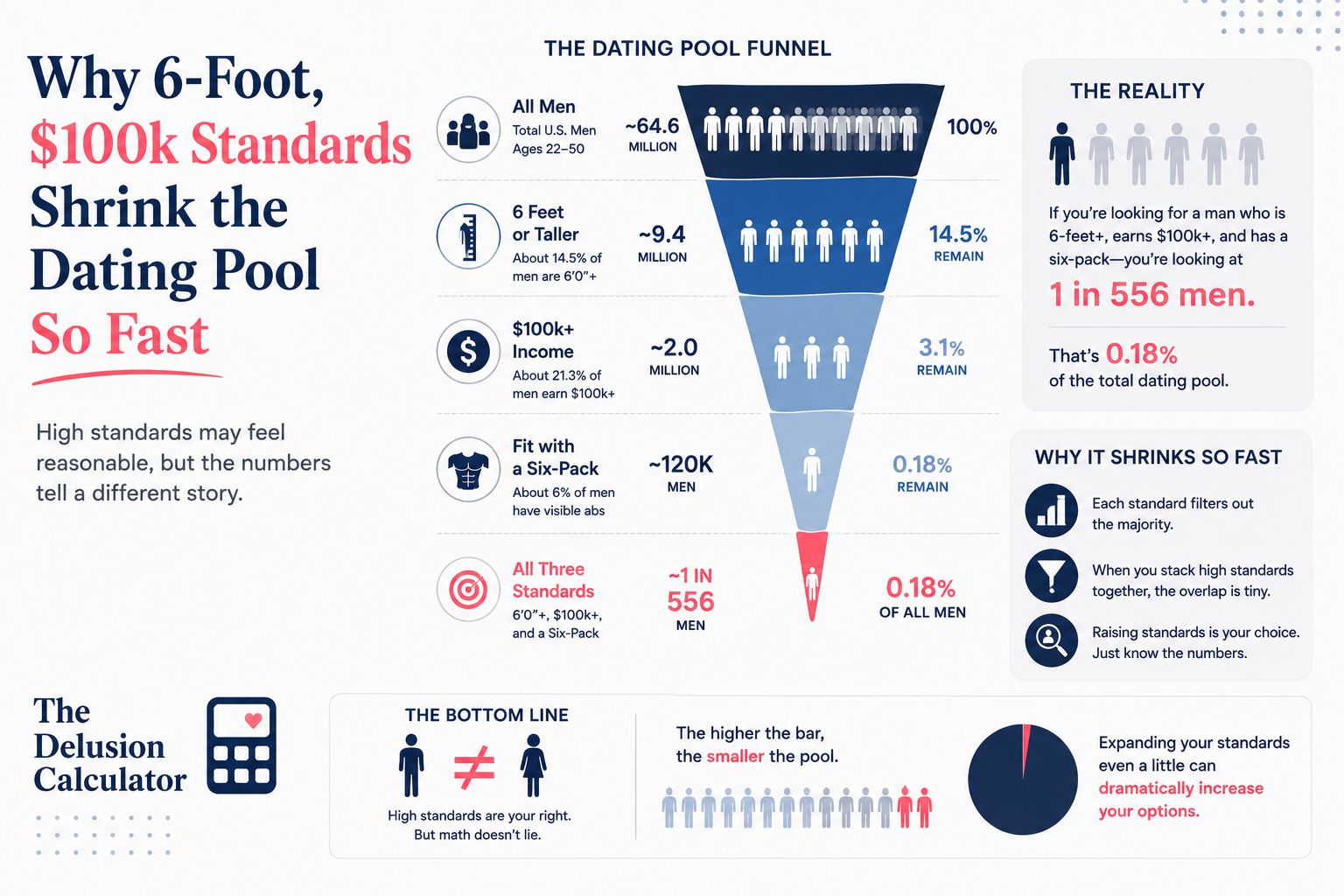
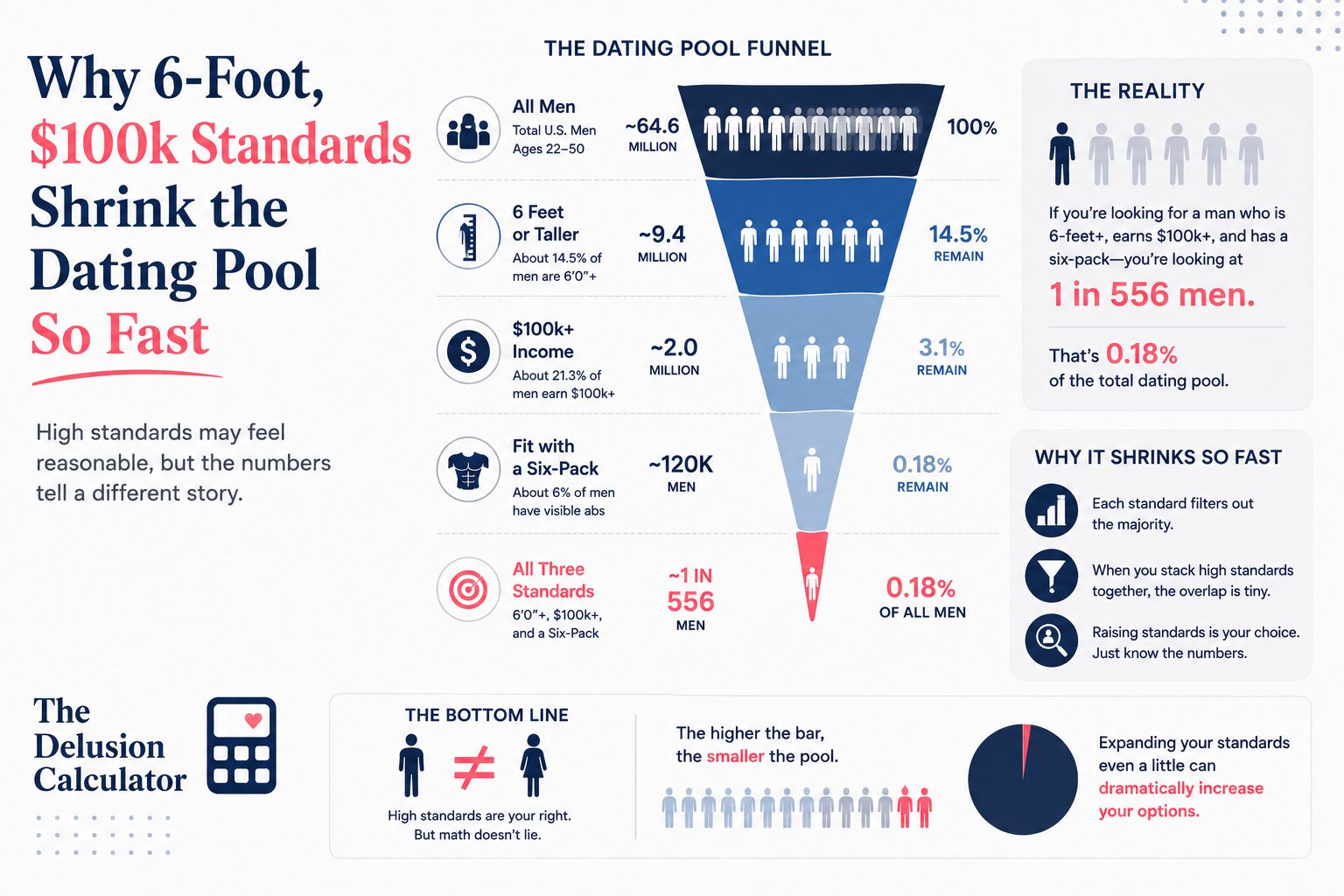
Ask for a man who is six feet tall and earns six figures, and each request sounds ordinary. Plenty of men are tall. Plenty earn well. So why does the pool of men who are both fall to around 2.2%, and why does a third filter push it near 1 in 1,000? The answer is one idea from probability that almost nobody applies to dating: filters multiply. This article shows exactly how two fair-sounding standards turn into a needle in a haystack, using real US numbers you can check.
None of this argues against having standards. It's a look at the arithmetic underneath them, so you can see where a wishlist tips from selective into statistically improbable, and what to change if it does.
Each filter looks reasonable on its own
Reasonable is the trap. Take the two most talked-about filters in the dating debate and look at them alone. Only about 14.5% of US men are six feet or taller, a figure the CDC gets by physically measuring people rather than asking them. And roughly 15% of individual men earn 100,000 dollars a year or more, from Census and Bureau of Labor Statistics data. Neither is exotic. One in seven men clears six feet. Around one in seven clears the income line. On their own, both feel like a normal thing to want.
The trouble starts the instant you want both in the same person. That's where multiplication takes over.
Why the two filters multiply instead of add
Multiply, don't average: that's the rule people skip. When two traits are roughly independent, the share of the population with both is the first percentage times the second, not the two blended together. Being tall doesn't make a man richer, so height and income sit close to independent. Run it and 0.145 times 0.15 gives 0.0217, about 2.2% of men, a little over 1 in 46.
Sit with that for a second. You didn't ask for anything rare. You asked for two common things at once, and the overlap of two common things is uncommon. It's the same reason a coin landing heads is easy but landing heads five times running is not. Each condition is likely. The stack is not.
The 6-6-6 rule and the 1-in-1,000 wall
Three sixes is where this gets its nickname. The online shorthand is the 6-6-6 standard: six feet tall, six figures, and a six-pack. Bolt that third filter onto the first two and the pool thins again. Fewer than half of men carry the low body fat a visible six-pack implies, so one more multiplication lands you near 1 in 1,000 American men. In a room of a thousand random guys, expect roughly one to tick all three boxes.
And that's before a word about age, location, whether he's single, or whether the two of you would enjoy a single dinner together. The 6-6-6 figure is a ceiling, not a floor. Real searches only head down from there.
Add age, and the floor drops out
Age is the quiet multiplier. Most people don't want a partner across the whole adult span. They want someone inside a ten-year window. But any ten-year band holds only a slice of the population. Ages 27 to 37, for example, cover about 20% of adult men. Layer that onto the tall-and-rich filter and the surviving pool slides from roughly 2.2% to well under 1%. Here's the same search built up one filter at a time, starting from the roughly 128 million adult men in the US:
| Filter stacked on | Share kept | Men remaining |
|---|---|---|
| All US men | 100% | about 128 million |
| Ages 27 to 37 | about 20% | about 26 million |
| Six feet or taller | 14.5% | about 3.7 million |
| Earns 100k or more | about 18% | about 680,000 |
| Single or available | about 55% | about 370,000 |
Five filters, none of them wild, and the pool went from 128 million to about 370,000. That's roughly 1 in 350 of the men you could date. The list still reads as normal. The result does not.
The haystack, in plain terms
Haystacks help here. Imagine every eligible man as a single straw in a field. The first filter burns most of the field. The second burns most of what's left. By the fifth, you're combing a small patch for the few straws that survived every fire. Nobody set out to make the search impossible. Each fire was reasonable on its own. The field just can't survive five of them and stay large. That's the whole story of why a modest-sounding list feels so hard to fill in practice.
One correction that softens the fall
Correlation is the single thing that pulls the other way. If you also ask for a college degree on top of the high income, plain multiplication would slash the pool again. But income and education aren't independent. Men who earn six figures are already far more likely to hold a degree, so the two filters overlap heavily. Counting them as separate hurdles would penalize the same men twice.
A good calculator accounts for this. It links income and education, anchors the pair to the tighter of the two, and softens the second, which can widen the resulting pool by 50% or more versus naive multiplication. So a degree requirement costs far less than it looks like it should, precisely because the high earners you're already selecting tend to have one. Height and income get no such discount, because tall men aren't systematically wealthier.
It is never really about one filter
Blame rarely sits with a single trait. People argue over whether six feet is fair, or whether six figures is shallow, but that framing misses the mechanism. No lone filter here is the problem. The compounding is. Drop any one of the five and the pool roughly doubles or triples. Keep all five and it stays small no matter how you feel about each one.
This is why a tool that shows your biggest constraint beats an argument. It doesn't call your standards wrong. It shows that height is cutting more than income, or that your age band is quietly the strictest filter of all, so you can pick what to loosen with your eyes open.
How to widen the pool without giving up what matters
Widening the pool is mostly about the tightest gate, not the one you argue about most. A few moves that tend to help:
- Stretch the age range. Going from a ten-year band to a fifteen-year band can lift the pool by half or more, often the single biggest gain on the table.
- Trim the height floor by an inch. Dropping from six feet to five foot eleven roughly doubles the eligible men, because you're moving across the fattest part of the height curve.
- Split must-haves from nice-to-haves. Choose the two filters you won't move on and let the rest flex. Two hard filters and three soft ones beat five hard ones every time.
Notice what's missing from that list: settling. Widening a pool isn't lowering standards. It's spending your strictness where it counts and easing it where it doesn't.
Two filters most people underrate
Underrated filters do quiet damage. Age is the first. A ten-year band feels generous until you notice it already removes about 80% of adults before any other trait is set. Availability is the second. Somewhere between a third and a half of adults in a given age range are married or partnered, so an "available only" filter can halve the pool on its own. Neither shows up in the usual six-foot, six-figure argument, yet together they often cut more than height and income combined. When a result surprises you, one of these two is usually the reason.
A quick word on self-reported height
Self-reported height is where a lot of the confusion starts. On apps and in surveys that simply ask, a striking share of men list themselves at six feet. Measured studies tell a quieter story. The CDC's National Health and Nutrition Examination Survey stands people against a wall, and there the six-foot share settles near 14.5%. The gap isn't really lying, it's rounding: five foot eleven becomes six foot, and a good slice of the male population promotes itself an inch. When you set a height filter, the calculator uses the measured figure, not the flattering one, which is why the pool it hands back is smaller than app profiles might suggest.
The same math runs in reverse for men
Men aren't exempt from any of this. Flip the search and the compounding works identically against a man looking for women. Wanting a partner who is young, single, and fit inside a tight age band stacks the same way. Only about 1 in 6 adult women are between 20 and 29, roughly 42% of women have a BMI of 30 or higher, and availability shifts hard with age. Multiply those and a man's "reasonable" list shrinks his pool just as fast. The male delusion calculator runs the identical engine against the female population, so both sides can check their own arithmetic instead of trading opinions.
What the pool size does not tell you
Pool size is a proportion, not a prophecy. A search that returns three-tenths of a percent still points at hundreds of thousands of real men, more than anyone meets in a lifetime. The figure also says nothing about chemistry, timing, or whether a match on paper survives a first dinner. So a thin pool is a reason to think about which filters to spend, not a reason to give up. Read it as the lay of the land, then go live inside it.
Why this debate never seems to end
Debate is what fills the space when nobody shows the math. The male and female delusion argument runs in circles because each side trades opinions about what counts as fair. Numbers cut through that. Once you can see a five-filter search leaving 1 in 350, the question stops being "are these standards shallow" and becomes "which of these five do I truly care about." That's a sharper question, and it's one you can answer for yourself in about a minute.
Frequently asked questions
What percentage of men are six feet tall?
About 14.5% of US men are six feet (183 cm) or taller, based on measured CDC data. Only around 3% reach six foot two, and close to 1% hit six foot four. Self-reported surveys show higher numbers because people round their height up, which is why measured data matters.
How many men earn six figures?
Roughly 15% of individual US men earn 100,000 dollars a year or more. The share climbs among full-time workers in their peak earning years and falls across all adults, so the exact figure depends on the age range you set. Ask for six figures inside a prime-age band and you're closer to 18%.
Why do two common traits become rare together?
Two common traits become rare together because independent probabilities multiply. If 15% of men are tall and 15% earn well, the share who are both is 15% of 15%, which is about 2%, not 15%. Each filter keeps only a fraction of what the last one left, so overlaps shrink fast even when every single trait is ordinary.
Is the 6-6-6 standard realistic?
The 6-6-6 standard describes about 1 in 1,000 American men, so it's real but rare. Roughly one man in a thousand is six feet tall, earning six figures, and lean enough for a visible six-pack, before you add age, location, or availability. It's fine to want, but you're searching a very thin slice of the population.
Does adding a degree requirement shrink the pool as much as income?
No, a degree requirement usually costs less than it appears, because income and education overlap. Men who already clear a six-figure income are far more likely to hold a degree, so a good calculator softens the second filter and the pool barely moves. Height and income, by contrast, are independent, so stacking those two cuts the pool in full.
Which shrinks the dating pool more, height or income?
Height usually shrinks the pool slightly more than income at the six-foot mark, since 14.5% of men clear six feet against roughly 15% who earn six figures. Push the bar to six foot two and height dominates completely, cutting to about 3% of men where a 100,000 dollar income still keeps around 15%. The higher you set the height floor, the more it outweighs everything else.
Does location change these numbers?
Location changes the raw count of people but not the underlying percentages by much. A big city holds more tall high earners in total, yet the share of men who are both stays close to the national figure. The calculator reports national proportions, so a dense metro gives you more bodies to search, not a friendlier ratio.
How can I make my dating pool bigger?
Widen your age range first, since it's often the strictest filter, then relax your single tightest requirement rather than trimming everything a little. Dropping a height floor by one inch or stretching an age band by five years typically does more than loosening three filters at once. Decide which two traits are non-negotiable and let the rest flex.
Standards aren't the enemy here, and neither is math. The pool shrinks fast because filters multiply, and once you can see that happening, you get to choose where to spend your strictness. A short list of hard limits and a longer list of soft preferences will always beat a long list of hard limits. Run your own numbers, find the filter doing the most damage, and change one thing at a time. The goal isn't a lower bar, it's a clearer one.