What Percentage of Men Are 6 Feet Tall? The Measured Answer
On this page
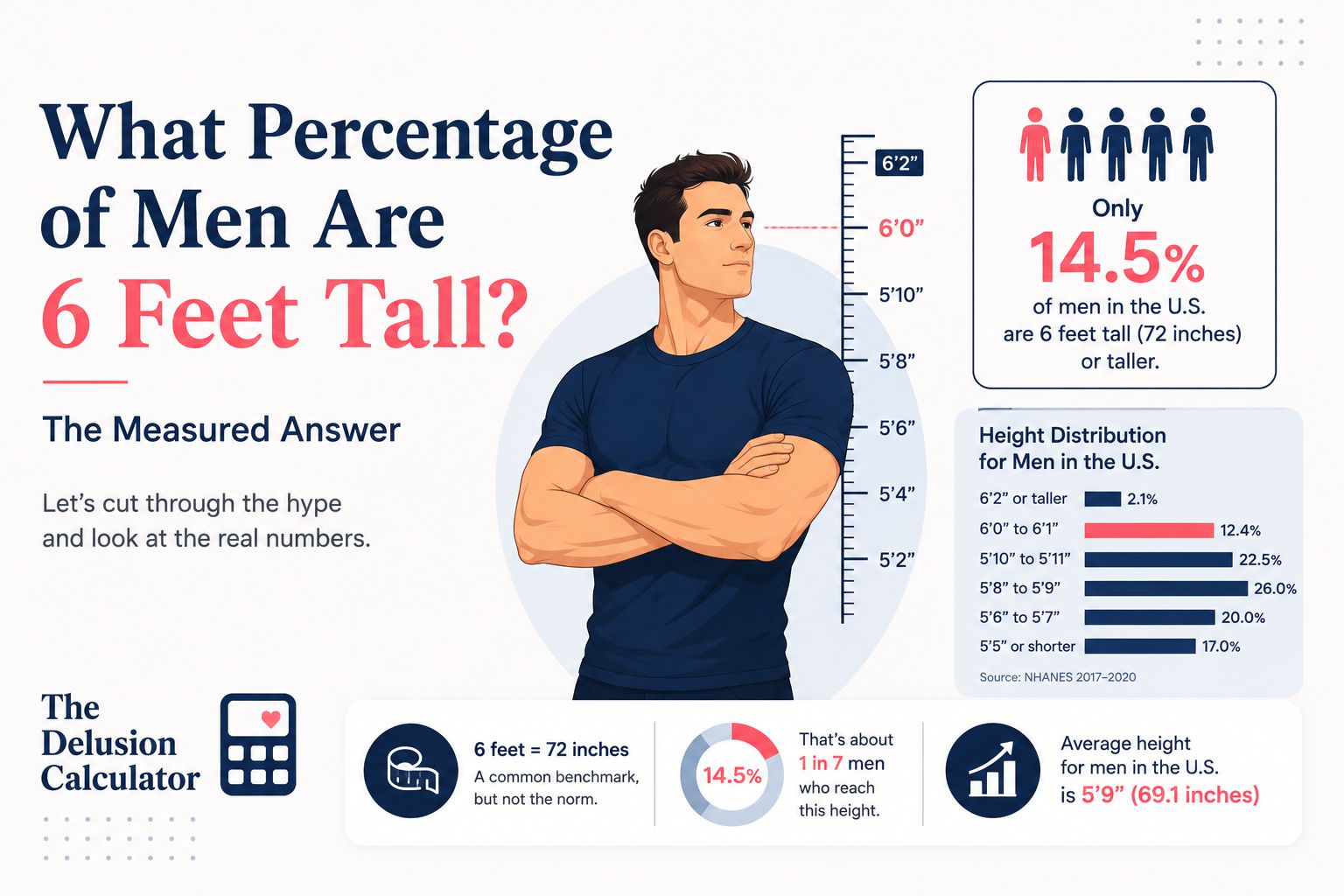
About 14.5% of American men stand 6 feet or taller. That is roughly one in seven, or close to 19 million men out of the 128 million adult men in the country. Yet surveys keep finding that around a third of men report being six feet. Both figures are real. One comes from a tape measure, the other from a text box. The average American man measures 5 feet 9 inches, or 175.4 cm, and the curve falls away sharply above that. This guide gives the full distribution inch by inch, compares the United States against the Netherlands and Japan, and shows exactly what a six-foot filter does to a dating pool.
The measured number, and the number men type into apps
Measured height comes from the CDC's National Health and Nutrition Examination Survey, which stands people against a stadiometer rather than asking them. On that evidence, 14.5% of adult men reach 183 cm. Self-reported height comes from dating profiles and questionnaires, where roughly 33% of men claim the same mark.
The gap is not mass dishonesty. It is rounding, shoes, and old measurements from a physical years ago. Five foot eleven and a half becomes six foot. A half inch of generosity, repeated across millions of profiles, doubles the apparent supply of tall men. Anyone who has ever met a "six-foot" match and found themselves eye to eye already knows this.
So when you set a height filter, remember which population you are filtering. Apps show you self-reported height. The distribution below shows you reality.
Full height distribution for American men
Distribution here means cumulative share: the percentage of adult men who stand at or above each mark. These figures are modeled from the CDC mean of 175.4 cm and its standard deviation of about 7.15 cm, which is the fit our calculator runs on. It reproduces the published six-foot anchor almost exactly, at 14.8% against the CDC's 14.5%.
| Height | Share of US men at or above | Odds | Men nationally |
|---|---|---|---|
| 5 ft 8 in | 50.6% | about 1 in 2 | 65 million |
| 5 ft 10 in | 36.9% | about 1 in 3 | 47 million |
| 5 ft 11 in | 24.5% | about 1 in 4 | 31 million |
| 6 ft 0 in | 14.8% | about 1 in 7 | 19 million |
| 6 ft 1 in | 8.1% | about 1 in 12 | 10 million |
| 6 ft 2 in | 4.0% | about 1 in 25 | 5.1 million |
| 6 ft 3 in | 1.7% | about 1 in 58 | 2.2 million |
| 6 ft 4 in | 0.7% | about 1 in 147 | 0.9 million |
Read the middle rows carefully, because that is where the cost lives. Moving your floor from 5 foot 11 to 6 foot 0 removes roughly 12 million men. One inch. Moving again to 6 foot 2 removes another 10 million. Each inch above the mean cuts harder than the one before it, because you are climbing the steep shoulder of a bell curve. Which is exactly what makes an extra inch so expensive.
Why one inch costs so much
Bell curves concentrate people near the middle. Most American men cluster between 5 foot 6 and 5 foot 11, so a filter set inside that band barely trims the field. Set it just above and you start slicing into the thin part of the distribution, where each additional inch removes a larger fraction of whoever is left.
Run the arithmetic. At 5 foot 11 you keep about a quarter of men. At 6 foot 0 you keep about a seventh. At 6 foot 2 you keep one in 25. The share does not fall in a straight line. It falls off a shelf. That's the single most useful thing to understand about height preferences, and it holds in every country, only with the shelf placed at a different mark.
How US men compare globally
Globally, six feet means very different things depending on where you're standing. The Dutch are the tallest measured population on earth, and roughly half of Dutch men clear the mark that only one in seven American men reach.
- Netherlands: average 182.5 cm, with about 50% of men at 6 feet or taller.
- Denmark: average 181.4 cm, with roughly 40% clearing six feet.
- Germany: average 180.3 cm, and close to 30% at six feet.
- United States: average 175.4 cm, and 14.5% at six feet.
- Brazil: average 174 cm, with about 11% reaching the mark.
- Japan: average 171 cm, and roughly 7% of men at six feet.
- India: average 168 cm, where about 4% of men stand six feet.
Worldwide, the average adult man measures around 171 cm, and only about 5% of men on the planet reach 183 cm. So a six-foot preference is a top-15% requirement in America and a top-5% requirement globally. Within the United States the picture also shifts by group.
Height by race and ethnicity in the US
Race shifts the mean by a few centimetres, which is enough to move the six-foot share by a lot. Non-Hispanic White men average about 177.4 cm, and somewhere near 18% to 20% reach six feet. Non-Hispanic Black men average roughly 176.4 cm, with about 16% to 18% clearing it. Hispanic men average close to 169.5 cm, where the six-foot share falls to about 7% to 9%. Asian American men average near 169.7 cm, with roughly 4% to 6% at six feet.
Those gaps are small in absolute terms. An 8 cm difference in the mean sounds trivial. On a bell curve it quadruples the share of men clearing a tall threshold, which is another way of seeing how brutally the tails behave.
Does age change the numbers?
Age matters at both ends. Men aged 20 to 39 average 176.1 cm. Men aged 40 to 59 average 175.8 cm. Past 60 the average drops to 173.4 cm, because spinal compression takes roughly a tenth to a fifth of an inch per decade after 40, and because older cohorts were born into worse childhood nutrition.
Practically, a woman searching within a 25 to 35 age band is drawing from a slightly taller pool than the national average implies. The effect is real but small, worth perhaps half a percentage point on the six-foot share. Income and marital status will move her pool far more.
What a six-foot filter costs you
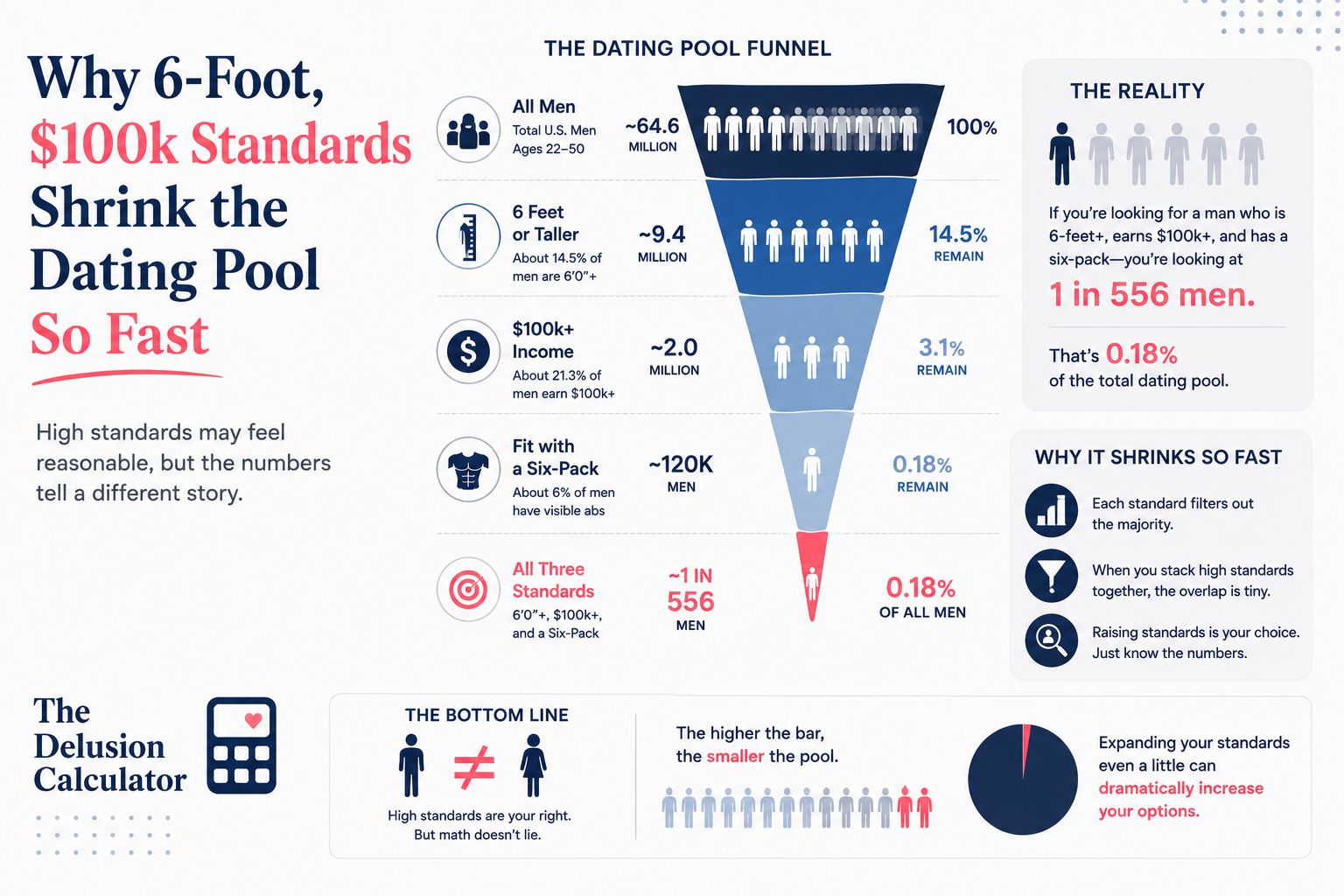
Filters stack multiplicatively, and height is usually the tightest gate anyone sets. Keeping 14.8% of men means discarding 85 of every 100 before a single other preference applies. Add a six-figure income floor, which keeps roughly 18% of adult men, and the survivors fall to about 2.7%. Layer on an age band and a requirement that he be single, and you land near half a percent.
Here is the same search built one filter at a time, starting from 128 million adult men:
| Filter added | Share kept | Men remaining |
|---|---|---|
| All US men | 100% | 128 million |
| Aged 27 to 37 | about 20% | 26 million |
| 6 feet or taller | 14.8% | 3.8 million |
| Earns $100,000 or more | about 18% | 690,000 |
| Not currently married | about 55% | 380,000 |
Four ordinary-sounding requirements, and the field drops from 128 million to under 400,000, roughly one in 340 of the men you could date. Notice that height did more damage than income. Drop the floor to 5 foot 11 and the final pool roughly doubles. You can test that trade in about a minute with the female delusion calculator, which runs this exact arithmetic on live distributions.
Where the numbers come from
Every measured figure above traces to the CDC's National Health and Nutrition Examination Survey, which physically measures a representative sample of Americans rather than trusting them to report their own bodies. Population counts come from the US Census Bureau's American Community Survey. International averages come from the NCD Risk Factor Collaboration, the group that pools national health surveys into comparable estimates.
Our per-inch table is modeled, not tabulated. We fit a normal distribution to the published mean and standard deviation, which is standard practice and accurate to within a point or so across the range people actually filter on. The full source list, with years and versions, sits on the methodology page.
Frequently asked questions
What percentage of men are 6 feet tall?
About 14.5% of US men stand 6 feet (183 cm) or taller, roughly one in seven. The figure comes from measured CDC data. Surveys that ask men to report their own height return closer to 33%, because people round upward.
Is 6 feet actually tall for a man?
Yes. Six feet places a man in roughly the top 15% of American men and the top 5% worldwide. It sits about three inches above the US male average of 5 foot 9, which is far enough up the curve to be genuinely uncommon rather than merely above average.
What is the average height for American men?
The average measured height is 5 feet 9 inches, or 175.4 cm. Median height sits marginally lower, near 5 foot 8.9. Men aged 20 to 39 run slightly taller at 176.1 cm, while men over 60 average 173.4 cm.
What percentage of men are over 6 foot 2?
About 4% of US men, roughly one in 25, reach 6 foot 2 or taller. At 6 foot 3 the share falls to 1.7%, and at 6 foot 4 only 0.7% of men qualify, which is about one in 147.
Do men lie about their height on dating apps?
Most exaggerate rather than lie outright. Measured data puts 14.5% of men at six feet while self-reports put roughly 33% there, a gap of about two and a half times. Rounding a half inch upward, keeping an old measurement, and measuring in shoes explain most of it.
Which country has the tallest men?
The Netherlands has the tallest measured men, averaging 182.5 cm, which is close to six feet exactly. Denmark follows near 181.4 cm and Germany near 180.3 cm. Roughly half of Dutch men clear the six-foot mark that only a seventh of American men reach.
How does a 6-foot requirement affect my dating pool?
A six-foot floor removes 85 of every 100 men before any other preference is applied. Combine it with a six-figure income and the pool falls to about 2.7% of adult men. Add an age band and a single-only filter and roughly one in 340 survive.
Which cuts the pool more, height or income?
Height cuts harder at the six-foot mark. A six-foot floor keeps about 14.8% of men against 18% for a $100,000 income. Raise the bar to 6 foot 2 and the gap widens sharply: 4% of men qualify on height, while 8.8% still clear a $150,000 salary.
Does height vary by race in the United States?
Yes, by a few centimetres at the mean. Non-Hispanic White men average 177.4 cm and Non-Hispanic Black men 176.4 cm, while Hispanic men average 169.5 cm and Asian American men 169.7 cm. Small shifts in the mean produce large shifts in the six-foot share.
Do men get shorter as they age?
Yes. Spinal discs compress and posture changes, costing roughly a tenth to a fifth of an inch per decade after 40. Measured averages fall from 176.1 cm for men aged 20 to 39 down to 173.4 cm for men over 60, though generational nutrition explains part of that gap too.
What is the "6-6-6 rule" and does anyone meet it?
The 6-6-6 rule asks for a man who is six feet tall, earns six figures, and has a six-pack. Stacking the three leaves somewhere between 1 in 400 and 1 in 1,000 American men, depending on how strictly you define visible abdominal definition. It began as satire on Twitter and resurfaced on TikTok in 2024.
Is measured height more reliable than self-reported height?
Yes, considerably. Measured surveys such as CDC NHANES use a stadiometer under controlled conditions, while self-reports inflate height by roughly half an inch to a full inch on average. Any statistic drawn from dating profiles or online questionnaires should be treated as an upper bound.
Height is one filter among several, and it is usually the one doing the most damage without anyone noticing. Set your own numbers, watch the pool move, and decide which inch you actually care about.