The 6-6-6 Rule Explained: How Rare Is Six Feet, Six Figures, a Six-Pack?
On this page
- What the three sixes stand for
- Where the 6-6-6 rule actually came from
- Six feet: about 14.5% of men
- Six figures: about 18% of men
- A six-pack: the number nobody measures
- Running the combined probability
- Add the filters that actually matter
- Is the standard serious, and does it matter?
- Where these numbers come from
- Frequently asked questions
The 6-6-6 rule asks for a partner who stands six feet tall, earns six figures, and carries a six-pack. Somewhere between 1 in 400 and 1 in 1,000 American men clear all three at once. That range is wide for a reason, and the reason is interesting: two of the three sixes are measured by federal surveys, and the third is measured by nobody at all. This piece traces where the rule actually came from (Twitter in 2015, not TikTok in 2024), separates the two competing definitions of the final six, runs the combined probability honestly, and shows what happens to the arithmetic when you swap a single assumption.
What the three sixes stand for
Sixes here are a shorthand, and the first two are unambiguous. Six feet means 183 cm of measured height. Six figures means an annual income of $100,000 or more. The third six is where versions diverge.
The sanitised modern form, the one that went viral in September 2024, reads the last six as six-pack abs. The original form, which circulated years earlier, read it as six inches, and was written as a deliberately crude joke. Some forum variants stack both and call it 6666. Psychology Today treats the third six as "abs or at least six inches," which tells you how unsettled the definition remains. Throughout this article the third six means visible abdominal definition, because that is the version people now search for.
Where the 6-6-6 rule actually came from
Origin stories for this one are mostly wrong. The rule did not start on TikTok in 2024. Archival tweets place it on Twitter as early as February 2015, with the format resurfacing in December 2018 through accounts trading it as a punchline. In that first life it was satire written by women, a mirror held up to shallow male checklists, not a sincere shopping list.
What happened in September 2024 was a resurgence, not a birth. TikTok picked the phrase up, swapped the crude six for six-pack abs, and mainstream outlets covered it within a fortnight. The satire flattened on the way through. By the time it reached the second wave of coverage, plenty of readers took the rule at face value, and plenty of commentators built careers on being furious about it.
Both readings survive today. Treat anyone quoting it as either joking or serious at your peril, because the phrase carries both. What it does not carry is a clear number, which is where most coverage stops and the arithmetic starts.
Six feet: about 14.5% of men
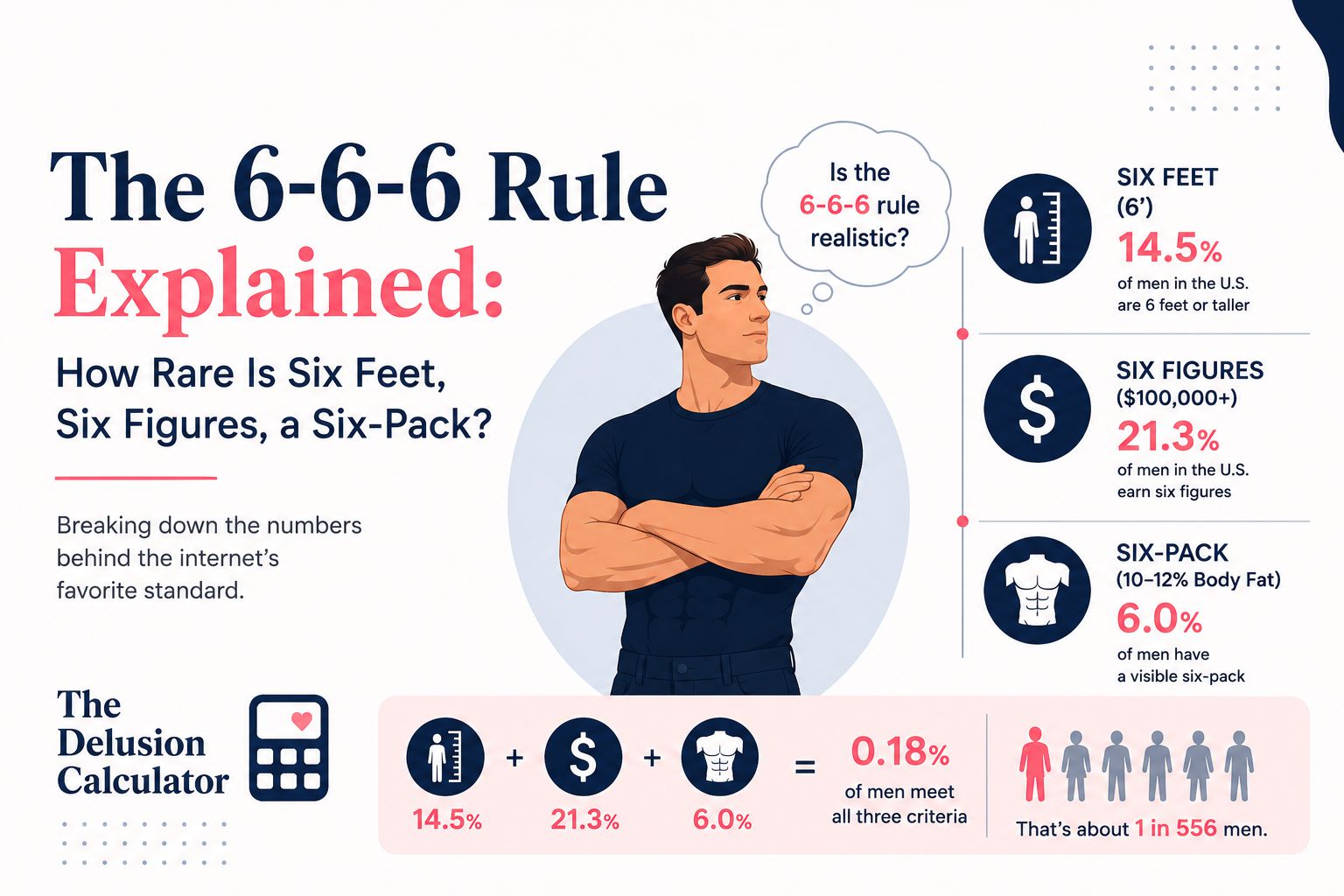
Height is the best measured of the three. The CDC's National Health and Nutrition Examination Survey stands people against a stadiometer, and finds 14.5% of adult American men at 183 cm or taller. That is roughly one in seven, against a male average of 5 foot 9.
Ask men to report their own height and about a third claim six feet. The gap is rounding, not fraud. For any honest calculation, use the measured figure. Our full breakdown of male height by inch shows how fast the curve thins above the mean.
Six figures: about 18% of men
Income depends entirely on who you count. Among all adult men, roughly 18% earn $100,000 or more. Among men who work full time, all year, the share climbs to about 28%. Psychology Today's coverage of the rule quotes 25%, which is a full-time framing.
Use the all-adults figure when you are talking about a dating pool, because a dating pool contains part-timers, students, and retirees. Use the full-time figure when you are talking about careers. Quietly swapping between them is how the same rule gets described as both common and impossible. The income distribution in detail separates the three framings.
A six-pack: the number nobody measures
Abs are the weak link, and almost no coverage admits it. No federal survey records whether an American has visible abdominal definition. The CDC measures body mass index and waist circumference. Neither tells you whether someone's rectus abdominis is visible under the skin.
What we can say is physiological. Visible abs generally require body fat somewhere below 12% for men, and often below 10% for the striated look people picture. Estimates of how many adult men sit in that range run from about 4% to 10%, depending on whether you count trained athletes only or anyone naturally lean. Roughly 43% of American men are obese, and a further slice are simply average, which prunes the field before training enters the picture.
So the honest position stays a range, not a point. That single uncertainty is what makes every published figure for this rule disagree with every other one.
Running the combined probability
Combining the three means multiplying, not averaging. The traits are close to independent: being tall does not make a man rich, and being rich does not give him abs. Multiply the shares and you get the joint probability.
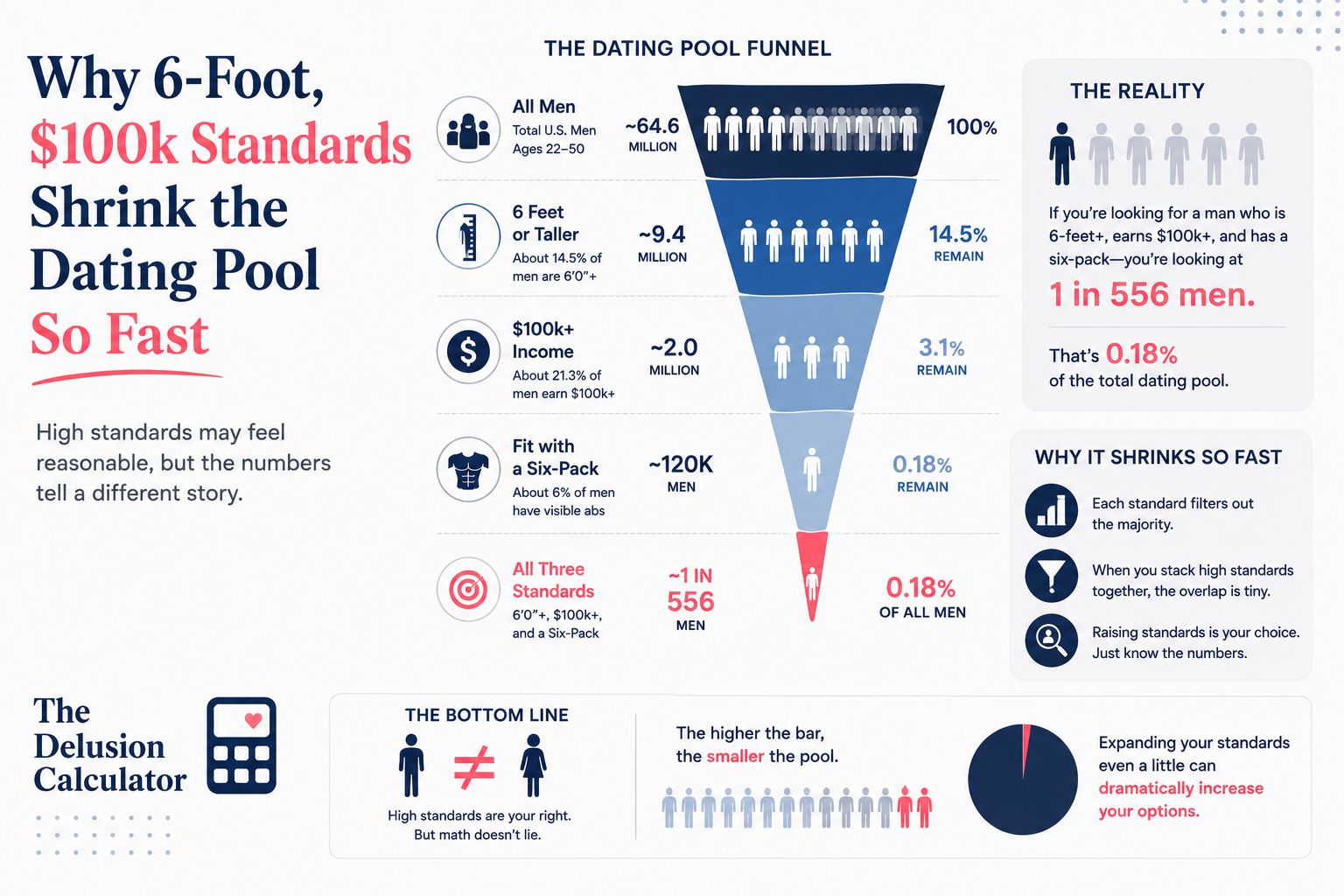
Start with the two solid numbers. Height at 14.5% times income at 18% gives 2.6% of men, or about one in 38, who are both six feet tall and earning six figures. That alone is a striking cut, and it happens before anyone mentions a gym.
Now add the third six, using the range rather than a guess.
| Assumed share of men with visible abs | Men meeting all three sixes | Odds |
|---|---|---|
| 10% (generous) | 0.26% | about 1 in 383 |
| 8% | 0.21% | about 1 in 479 |
| 6% | 0.16% | about 1 in 639 |
| 4% (strict) | 0.10% | about 1 in 958 |
Every row sits under 1%, which is why Psychology Today's "less than one percent" holds regardless of the assumption you pick. The popular "one in a thousand" shorthand corresponds to the strictest reading of a six-pack. The friendlier "one in 400" corresponds to the loosest. Anyone quoting a single confident figure has silently chosen one of these rows for you.
Put the strictest row in human terms. About 130,000 American men would meet all three sixes at the 4% assumption. Spread across a country of 128 million adult men, that is one per small town. And none of those numbers has yet asked whether the man is single, near you, or interested.
Add the filters that actually matter
Age and availability finish the job. Restrict the search to men aged 27 to 37 and you keep roughly a fifth of the pool. Require that he not be currently married and you keep about 55% of that. Apply those to the middle of our range and the count of qualifying men nationally falls into the low tens of thousands.
Fixed. That is the whole trick of the rule. It is not that any one six is outrageous. It is that three plausible requests, multiplied, produce a number smaller than most people's mental arithmetic can hold. Test the compounding yourself with the female delusion calculator, which runs the same distributions live.
Is the standard serious, and does it matter?
Seriousness is genuinely contested. Survey work from dating apps suggests roughly 80% of women say they are open to relaxing their stated standards, which sits awkwardly beside the idea of a rigid checklist. Matchmakers who work with real clients tend to describe the format as a meme that few people apply literally.
Meanwhile the counter-examples write themselves. Tom Cruise stands 5 foot 7. Zac Efron is 5 foot 8. Neither has struggled. Height and income predict a partner's presence in a filtered search, not their presence in a happy relationship.
The useful reading is neither outrage nor endorsement. The phrase is a compact demonstration of compound probability that happens to be about dating. Grasping why it produces such a small number is worth more than deciding whether the people who quote it are villains.
Where these numbers come from
Height comes from CDC NHANES, which measures rather than asks. Income comes from the US Census Bureau's Current Population Survey and Bureau of Labor Statistics earnings tables. Marital status and age bands come from the Census American Community Survey. Population totals come from the same source.
The body-fat range is the one figure with no authoritative survey behind it, and we have labelled it as an assumption rather than dressing it up. Everything else, including the exact combining formula, is documented on the methodology page.
Frequently asked questions
What is the 6-6-6 rule in dating?
The 6-6-6 rule describes a partner who is six feet tall, earns six figures, and has a six-pack. It began as satire on Twitter around 2015, resurfaced on TikTok in September 2024, and now circulates as both a joke and a sincere checklist depending on who is quoting it.
How many men meet all three sixes?
Between 1 in 400 and 1 in 1,000 American men meet all three. Height accounts for 14.5% and a six-figure income for 18%, which alone leaves 2.6% of men. The final figure depends on how strictly you define visible abs, an attribute no federal survey measures.
Is the 6-6-6 rule real, or is it a joke?
It started as a joke. Archival tweets from 2015 and 2018 use the format as satire aimed at shallow male preferences, with a cruder third six. The 2024 TikTok revival sanitised it to six-pack abs and a share of the audience began treating it literally.
What does six figures actually mean?
Six figures means an income of $100,000 or more per year, so called because the number has six digits. Roughly 18% of all adult American men clear it, rising to about 28% among men who work full time, year round.
Which is rarer, six feet of height or six figures of income?
Height is rarer at those thresholds. Six feet keeps about 14.5% of men against 18% for a six-figure income. Push the height bar to 6 foot 2 and the difference widens sharply, with only 4% of men qualifying on height.
What percentage of men have a six-pack?
Somewhere between 4% and 10% of men, though no government survey measures it. Visible abdominal definition generally requires body fat under about 12%, and often under 10%. The CDC records body mass index and waist circumference, neither of which captures abdominal visibility.
Does the third six mean abs or six inches?
Both versions exist. The original 2015 form meant six inches and was written as a crude joke. The 2024 TikTok revival replaced it with six-pack abs, which is the version dominating search today. Some forum variants keep both and call the result 6666.
Do women actually use the 6-6-6 rule to filter men?
Rarely, at least in the strict sense. Dating-app survey work suggests around 80% of women describe themselves as open to relaxing their stated criteria, and working matchmakers report almost no clients applying the rule literally. It functions more as internet shorthand than as a screening tool.
Is the 6-6-6 rule the same as the 6-7-8 rule?
No. The 6-7-8 variant is a newer escalation that circulated after the original went mainstream, raising the thresholds rather than changing their nature. Every escalation makes the arithmetic worse, because each added inch or dollar removes a larger slice of whoever remained.
Why do published estimates for the 6-6-6 rule disagree?
Estimates disagree because of the abs assumption. Set visible abdominal definition at 10% of men and the answer is 1 in 383. Set it at 4% and the same arithmetic gives 1 in 958. The height and income inputs barely move; the third six carries all of the uncertainty.
Are the three traits independent of each other?
Close to independent, which is why simple multiplication works here. Tall men are not systematically wealthier, and wealthy men are not systematically leaner. Income and education do move together, so a calculator that adds an education filter must correct for that overlap rather than multiply blindly.
Does meeting the 6-6-6 rule predict a good relationship?
No. The three sixes describe a man's position in three national distributions and say nothing about kindness, humour, or whether he'll remember your sister's name. Height and income predict who survives a filter, not who survives a marriage.
Compound probability is the whole story here, and it doesn't care how anyone feels about the rule. Pick your own three requirements, watch what multiplying them does, and decide which ones you'd actually trade.