On this page
- Why one question produces three answers
- What percentage of men make $100k a year
- How the six-figure share changes with age
- Women and the six-figure threshold
- Beyond $100k: $150k, $250k, and $1 million
- Six figures is not the same as feeling rich
- What a salary floor does to your dating pool
- Where these numbers come from
- Frequently asked questions
About 18% of adult men in the United States earn $100,000 or more. Narrow the group to men who work full time, all year, and the share climbs to roughly 28%. Count households instead of people and it rises again, to about 34%. Three numbers, one question, and none of them is wrong. They just describe different populations. This guide pulls the three apart, tracks how the six-figure share moves across age bands, follows the curve out to $250,000 and $1 million, and shows what an income filter does to a dating pool. Figures come from the US Census Bureau, the Bureau of Labor Statistics, and the earnings distributions our own calculator runs on. By the end you'll know which number to quote, and why so many articles quietly reach for the flattering one.
Why one question produces three answers
Answers diverge because the denominator changes. Ask what share of people clear six figures and you are dividing by every adult, including students, retirees, part-time workers, and anyone out of the labour force that year. Ask what share of full-time, year-round workers clear it and you have quietly deleted tens of millions of low or zero earners from the bottom of the distribution. Ask about households and you are adding two salaries together under one roof.
Here is the same threshold, measured three ways.
| Population measured | Share at $100,000 or more | What the denominator includes |
|---|---|---|
| All adult men | about 18% | Every man 18 and over, earners and non-earners alike |
| Men working full time, year round | about 28% | Only men with a full-year, full-time job |
| All US households | about 34% | Combined income of everyone under one roof |
The household figure is the one that circulates most, and it is the least useful if you're thinking about a single person. Two partners earning $55,000 each produce a six-figure household and zero six-figure individuals. That gap explains almost every argument about whether $100,000 is common or rare. Which brings us to the number most people actually mean.
What percentage of men make $100k a year
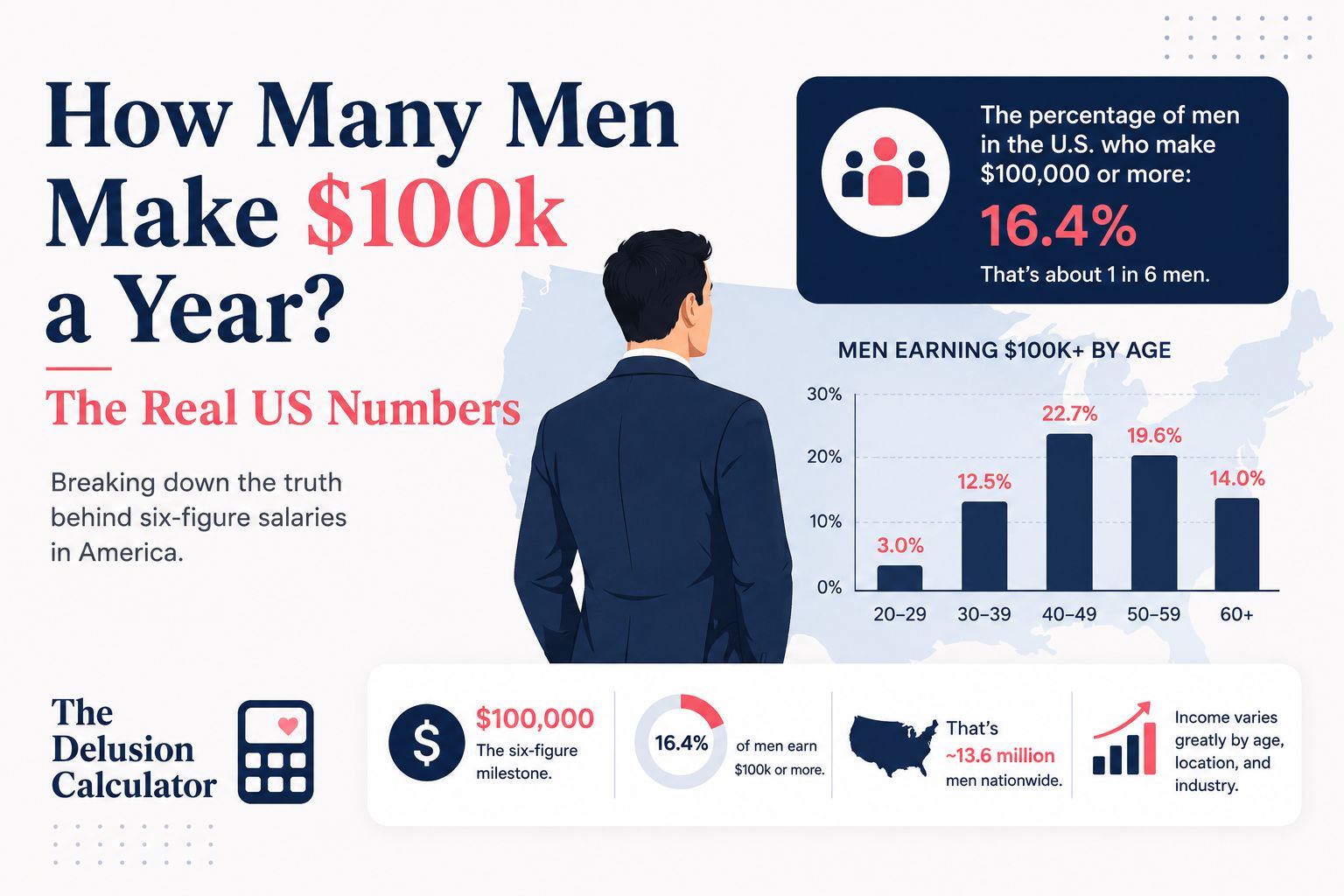
Men clear the six-figure line at roughly 18% when you count every adult man in the country. That is close to one in five, and it is the figure our calculator uses, because a dating pool contains retirees and part-timers, not only full-year employees. Published Census-based estimates for all men land near 17%, so the two agree within rounding.
The full-time number is the one that flatters. Among men employed full time and year round, about 28% earn $100,000 or more. Nothing is dishonest about that statistic. It answers a narrower question: given that a man works a full-year job, how likely is six figures? Both are true. Only one describes the people you might meet.
Median individual income sits far below either threshold, at roughly $44,000 a year across all workers. Median household income reached about $80,610 in 2023. So a man earning $100,000 alone out-earns the typical American household on his own. That is the honest scale of it.
How the six-figure share changes with age
Age moves this number more than almost anything else. Earnings rise steeply through the thirties, peak in the mid forties, then flatten and fall. A 23 year old and a 43 year old are not drawing from the same distribution, which is why an income filter behaves so differently depending on the age band beside it.
| Age band | Share earning $100,000 or more |
|---|---|
| 18 to 24 | about 7% |
| 25 to 34 | about 18% |
| 35 to 44 | about 25%, the peak |
| 45 to 54 | about 20% |
| 55 and over | about 16% |
Look at what that does to a search. Ask for a man aged 25 to 30 who earns six figures and you're fishing in a band where fewer than one in five qualify, and the younger half of it barely reaches one in ten. Ask for 38 to 45 and the same income filter suddenly keeps a quarter of the men. Same requirement. Very different odds. The age band you pick is doing more work than you think, and it does the same to the other side of the market.
Women and the six-figure threshold
Women reach $100,000 at about 9.8% across all adults, and roughly 18.5% among full-time, year-round workers. Put plainly, a man is close to twice as likely as a woman to clear the line. The gap narrows sharply among younger workers: women aged 25 to 34 earn about 95 cents for every dollar men earn, against roughly 83 cents across all ages.
That asymmetry matters for anyone building an income filter. A woman screening for a six-figure man is filtering roughly one in five. A man screening for a six-figure woman is filtering roughly one in ten. The same slider cuts twice as hard in one direction. It's one of the clearest places where the male and female versions of the same standard stop being symmetrical.
Beyond $100k: $150k, $250k, and $1 million
Thresholds above six figures thin out fast, and the drop is steeper than most people picture. Each rung roughly halves the field.
| Annual income | Adult men | Adult women | Odds for men |
|---|---|---|---|
| $50,000 or more | 47% | 35% | about 1 in 2 |
| $100,000 or more | 18% | 9.8% | about 1 in 6 |
| $150,000 or more | 8.8% | 4.1% | about 1 in 11 |
| $200,000 or more | 4.8% | 2.0% | about 1 in 21 |
| $250,000 or more | 2.8% | 1.1% | about 1 in 36 |
| $500,000 or more | 0.75% | 0.26% | about 1 in 133 |
| $1,000,000 or more | 0.19% | 0.06% | about 1 in 526 |
Notice the shape. Moving your floor from $100,000 to $150,000 does not trim the field by a third. It nearly halves it. Push to a quarter million and you have removed 84 of every 100 men who cleared your original bar. Income is a long right tail, and long tails punish small increases in ambition.
Six figures is not the same as feeling rich
Earning $100,000 buys wildly different lives depending on the zip code. In Manhattan that salary carries the spending power of roughly $30,000 after taxes and housing. In Memphis it behaves closer to $86,000. And a striking share of six-figure earners report living paycheck to paycheck, somewhere near 45% in recent surveys.
So a salary floor is a proxy, not a measurement of comfort. It tells you where a person sits in a national distribution. It says nothing about their rent, their student loans, or whether they can absorb a broken transmission. Worth remembering before treating the number as a personality trait. It's also worth seeing what it does to the pool.
What a salary floor does to your dating pool
Filters multiply. Ask for a man aged 27 to 37 who clears at least $100,000 and you have combined an age band holding roughly a fifth of adult men with an income cut keeping under a fifth of them. Add "single" and "not obese" and the survivors shrink again. Run that exact search and the pool lands near 0.5% of adult men, a little over half a million people nationally.
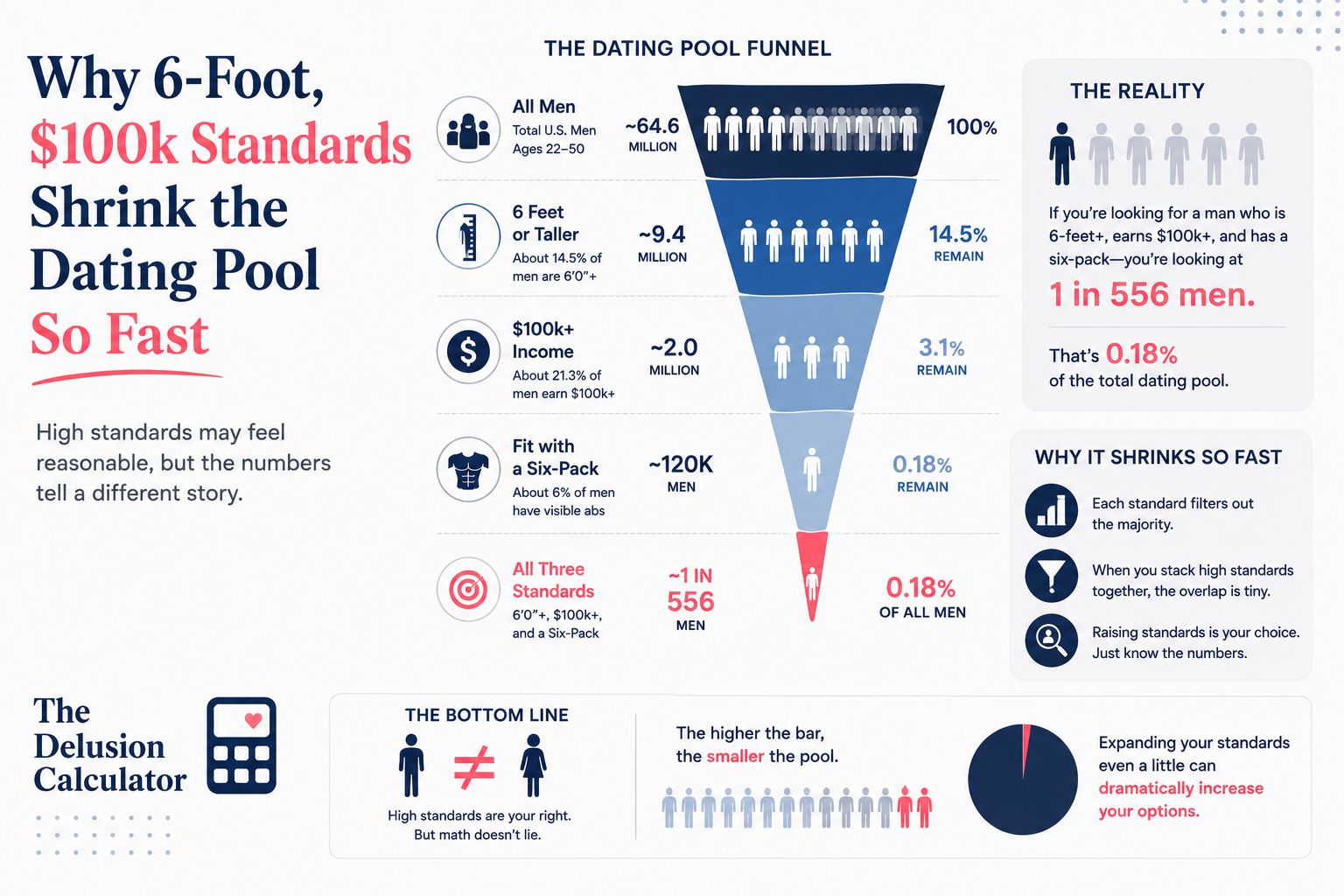
Two things follow. First, no single filter did the damage; the stacking did. Second, earnings are rarely the tightest gate. Height usually is. A six-foot floor keeps about 15 of every 100 men, which is a harder cut than $100,000. If you want a bigger pool, the arithmetic says trim your age band before you trim your income floor. You can test both in about a minute with the female delusion calculator or, if you're screening women, the male delusion calculator.
Where these numbers come from
Sources matter more than usual here, because the popular figures on this topic trace back to secondary aggregators rather than the surveys themselves. Individual earnings trace to the US Census Bureau's Current Population Survey and its PINC-01 income tables. Full-time, year-round worker figures come from the same survey's employment tables. Household income comes from the Census household series. Weekly earnings and the gender ratio are drawn from the Bureau of Labor Statistics.
Our distributions are documented, versioned, and dated on the methodology page, alongside the exact formula used to combine filters. Where our curve differs slightly from a headline you have read elsewhere, the reason is almost always the denominator, not the data.
Frequently asked questions
What percentage of men make $100k a year?
About 18% of adult US men earn $100,000 or more. Restrict the group to men working full time, all year, and the figure rises to roughly 28%. The lower number describes the men who exist; the higher one describes the men who hold full-year jobs.
What is median individual income in the US?
Median individual income runs to roughly $44,000 a year. Half of workers earn less than that, half earn more. Median household income is far higher, near $80,610 in 2023, because most households pool the earnings of more than one person.
What does "full-time, year-round worker" mean?
A full-time, year-round worker holds a job of 35 or more hours a week for at least 50 weeks of the year, which is the Census Bureau's definition. Excluding part-timers, seasonal staff, students, and retirees lifts every earnings percentage, which is why that framing produces the friendliest statistics.
Are men more likely than women to earn six figures?
Yes. Roughly 18% of men clear $100,000 against 9.8% of women, close to a two to one gap. Among full-time workers the split narrows to about 28% and 18.5%, and among adults aged 25 to 34 women earn about 95 cents per male dollar.
Which age group earns $100k most often?
Men aged 35 to 44 clear six figures most often, at roughly 25%. The share climbs from about 7% among 18 to 24 year olds, peaks in the early forties, then eases to about 20% for 45 to 54 and 16% past 55.
What percentage of households make over $100k?
About 34% of US households take home $100,000 or more. Households routinely contain two earners, so this figure runs roughly double the individual rate and should never be quoted as the odds of meeting one six-figure person.
How many men earn $200,000 or more?
Roughly 4.8% of adult men, or about one in 21, earn at least $200,000. At $250,000 the share falls to 2.8%. At half a million it reaches 0.75%, and only about 0.19% of men, one in 526, report a seven-figure income.
Is $100,000 a good salary in the United States?
Yes, by any national measure. A single earner on $100,000 out-earns the typical American household, whose median sits near $80,610. Cost of living scrambles that comfort, though: the same salary stretches roughly three times further in Memphis than in Manhattan.
Do most six-figure earners feel wealthy?
No. Close to 45% of $100,000 earners describe living paycheck to paycheck, and a similar share report thin savings. High income and high fixed costs frequently arrive together, especially in the coastal metros where six-figure jobs concentrate.
Does a college degree raise the odds of earning $100k?
Yes, substantially. Workers aged 25 to 34 with a bachelor's degree earn a median near $71,000 against $41,800 for those holding only a high school diploma. Degree holders also dominate the upper tail, which is why income and education must be treated as correlated rather than independent when filters are combined.
Which is rarer, a man earning $100,000 or a man standing 6 feet tall?
Height is the rarer trait. About 15% of US men reach 6 feet against roughly 18% clearing $100,000, so the height filter cuts slightly harder. Raise the bar to 6 foot 2 and it is not close: under 4% of men qualify, against 8.8% at a $150,000 income floor.
Why do different articles give different percentages?
Different articles measure different populations. One counts every adult, another counts only full-time workers, a third counts households, and each is arithmetically correct. Check the denominator before you compare two figures, because the same $100,000 line produces 18%, 28%, or 34% depending on who is standing in the room.
Income tells you where someone sits in a distribution. It doesn't tell you whether you'll like them. If you want to see how a six-figure floor interacts with age, height, and everything else you care about, run your own filters and watch the pool move.