On this page
- The headline share, stated precisely
- Educational attainment among US men, level by level
- What actually counts as a degree here
- How the number climbed since 1940
- The reversal: women pulled ahead and kept going
- Attainment by age band
- Why male attainment stopped climbing
- What an education requirement costs in a dating pool
- Reading the number honestly
- Frequently asked questions
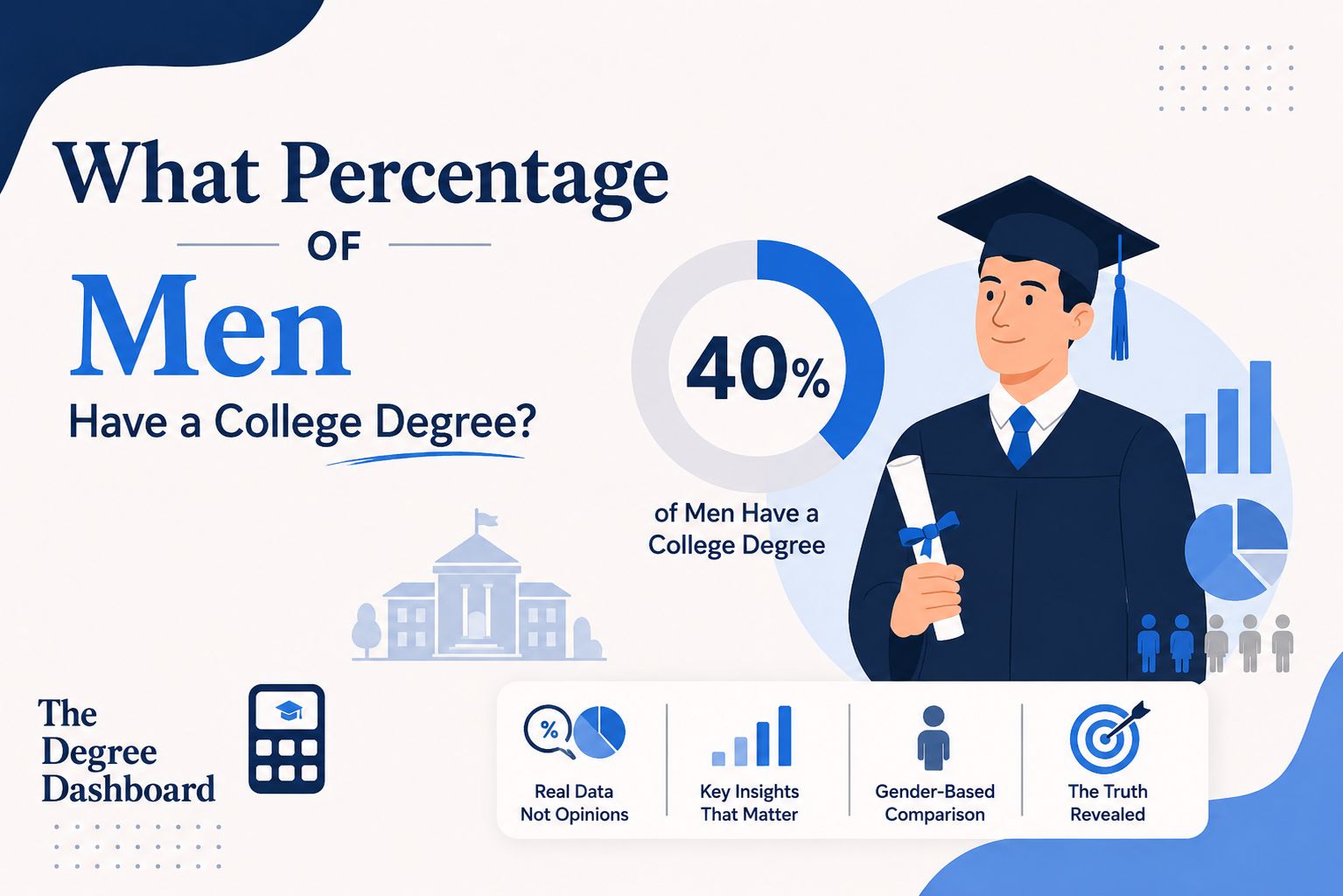
About 37% of American men aged 25 and older hold a bachelor's degree or higher. That works out to roughly 39 million men out of the 105 million in the bracket, a little better than one in three. Loosen the definition to include two-year awards and the figure climbs to about 46%. Tighten it to master's, doctoral, and professional study alone and it drops to roughly 14%. Each of those is a correct answer. Which one you want depends on what you mean by the phrase "college degree," and that ambiguity explains the wildly different numbers quoted across the internet.
The source for all of this is the Census Bureau, which measures schooling completed through the American Community Survey and the Current Population Survey. Both instruments put the same core question to hundreds of thousands of households every year, which is why attainment can be discussed with real precision rather than vibes. This guide gives the level-by-level split, traces how the numbers moved across eight decades, explains the reversal that put women ahead, breaks the share out by age band, and then does the part almost nobody bothers with: pricing what an education requirement actually costs inside a dating pool.
The headline share, stated precisely
Attainment statistics are almost always reported for the population 25 and over. There is a good reason for that cutoff. Plenty of 22-year-olds are still enrolled, so counting them would drag the measured figure down without telling you how many men eventually finish. By 25, most men who are ever going to graduate have already done it.
Within that population the split runs as follows. Roughly 23% of men stopped at a bachelor's. Another 14% went further into graduate or professional study. Add the two and you land on the 37% headline. Below that line sit about 9% with an associate degree, roughly 15% who enrolled somewhere and left empty-handed, around 28% whose schooling ended with a high school diploma or equivalency, and about 10% who never completed secondary school at all.
These percentages shift by a point or so each year as older cohorts age out and better-schooled younger ones age in. Treat them as accurate to the nearest whole point rather than the nearest decimal and you will never be badly wrong.
Educational attainment among US men, level by level
The table below shows each terminal level of schooling for the 25-plus population, the percentage sitting at that level, and an approximate national headcount. Population figures assume roughly 105 million men in the bracket, which is the working number our models run on. Shares are rounded, so the column will not sum to exactly 100.
| Highest level completed | Share of men 25+ | Approximate men nationally |
|---|---|---|
| Did not finish high school | 10% | 10.5 million |
| High school diploma or equivalency | 28% | 29 million |
| Some college, nothing earned | 15% | 16 million |
| Associate degree | 9% | 9.5 million |
| Bachelor's degree | 23% | 24 million |
| Graduate or professional degree | 14% | 15 million |
| Bachelor's or above (combined) | 37% | 39 million |
| Associate or above (combined) | 46% | 48 million |
Two rows deserve a second look. The "some college, nothing earned" line is the quiet story of American higher education: roughly 16 million men enrolled, accumulated credits, and walked away with nothing on paper. In a dating context these men usually get sorted alongside non-graduates, even though many of them completed two or three years of coursework.
The graduate row is the other one worth sitting with. Fourteen percent is not a rounding error. Roughly one man in seven studied past the bachelor's mark, almost exactly the rarity of being 6 feet tall. That coincidence turns out to be useful later.
What actually counts as a degree here
Census forms ask respondents for the highest level they completed, with separate response options for associate, bachelor's, master's, professional, and doctoral awards. An associate normally represents two years of study, most often at a community college, and it can be academic or occupational. A bachelor's represents four years at a degree-granting university. Professional awards cover law, medicine, dentistry, veterinary practice, and similar licensed fields.
Trade certificates, apprenticeship completions, and industry licenses do not register as degrees in this framework. A man who spent three years in an electrical apprenticeship and now runs his own shop gets recorded under high school or some college, depending on his classroom history. If you are using schooling as a rough stand-in for earning power, that omission matters, because the skilled trades pay competitively and skew heavily male.
The phrasing you choose therefore does real work. Ask whether he went to college and you are asking about something closer to 61% of men, since that count sweeps in everyone who ever enrolled. Ask whether he holds a four-year degree and you are asking about 37%. Two questions that sound similar describe populations differing by more than 25 million people.
How the number climbed since 1940
American attainment has risen almost without interruption for four generations. In 1940, when detailed figures were first collected, barely 5% of American men had finished four years of college. Most had not finished secondary school either. The postwar GI Bill changed the trajectory sharply, sending millions of veterans into classrooms that had previously served a narrow slice of the country.
By 1960 the university share among men had roughly doubled to about 10%. By 1980 it doubled again, reaching roughly 20%. Growth then slowed without stopping: the figure passed 27% around the turn of the millennium and has since ground upward to today's 37%. Across eight decades, the proportion of men holding an undergraduate qualification multiplied by about seven.
The secondary-school number moved even more dramatically. Fewer than a quarter of men had finished high school in 1940. Today roughly 90% have, which is why the bottom row of the table above is now the smallest category outside of specialized credentials. Both curves are flattening as they approach their practical ceilings, and the recent pace of increase for men specifically has been gentle.
The reversal: women pulled ahead and kept going
For most of the twentieth century men held a large advantage. In 1970 they were roughly twice as likely as women to have finished four years of college. That gap closed steadily, then inverted.
The first crossover happened in awards conferred. Women began earning the majority of bachelor's degrees handed out each year in the early 1980s, and their slice of new graduates has expanded almost every year since. Because attainment across the adult population reflects decades of accumulated graduating classes, the population-level crossover arrived much later. Around the middle of the 2010s women finally passed men on the population measure, and they have stayed in front. Today roughly 39% of adult women hold an undergraduate qualification, against 37% of men.
A two-point gap understates what is happening among the young. Among adults 25 to 34, the split runs far wider: close to 47% of women graduated from a four-year school compared with about 37% of men, a difference near ten points. Women also now earn most of the master's and doctoral awards granted annually. The old picture of the university as a male institution is roughly half a century out of date.
This reversal has direct consequences for dating markets, and it is one of the most under-discussed asymmetries in the whole conversation. A college-educated woman in her late twenties who wants a partner with matching schooling draws from a smaller group than her male counterpart does. She competes over 37% of men while sitting inside a 47% cohort. Our female delusion calculator models exactly this arithmetic, and education is one of the filters where the results surprise people most.
Attainment by age band
Splitting men into age groups reveals a curve rather than a straight climb. Younger cohorts are not uniformly better schooled than the ones before them, because male progress stalled somewhat after the 1990s while female progress kept accelerating.
- Men 25 to 34: roughly 37% carry a bachelor's or better. This cohort left school recently and includes late finishers who will nudge the figure up over the next decade.
- Men 35 to 44: around 40%, typically the peak band. Graduate programs completed during the thirties push this group above the younger one.
- Men 45 to 64: roughly 36%, reflecting cohorts schooled in the 1970s and 1980s while male enrollment was still climbing.
- Men 65 and over: about 33%, the lowest band, made up of men who reached university age before mass enrollment became normal.
The practical takeaway for anyone screening on education is that the odds barely move across the prime dating years. Whether you look at men in their late twenties or men in their early fifties, somewhere between a third and two-fifths will have a diploma. Contrast that with income, which climbs steeply as men age, or availability, which collapses as they marry off. Our breakdown of dating pool statistics by age walks through how differently those variables behave.
Why male attainment stopped climbing
Several forces push in the same direction here. Boys lag girls on nearly every measure of school readiness and engagement from the elementary grades onward, and they are less likely to graduate secondary school on time. Male enrollment at universities fell through the 2010s and dropped sharply during the pandemic years. Men who do enroll finish within six years at a somewhat lower rate.
Meanwhile the male-heavy alternatives are genuinely attractive. Construction, logistics, energy, and skilled manufacturing offer wages that compete with plenty of degree-track careers and skip the tuition bill entirely. A licensed tradesman in his late twenties can out-earn many graduates who are carrying student loan balances. None of that registers in an attainment statistic, which records classroom years and nothing else.
So the flat line for men is not straightforwardly a story of decline. Part of it is substitution. But whichever explanation you favor, the measured result is stable: attainment among men has moved only modestly in twenty years while the figure for women kept rising.
What an education requirement costs in a dating pool
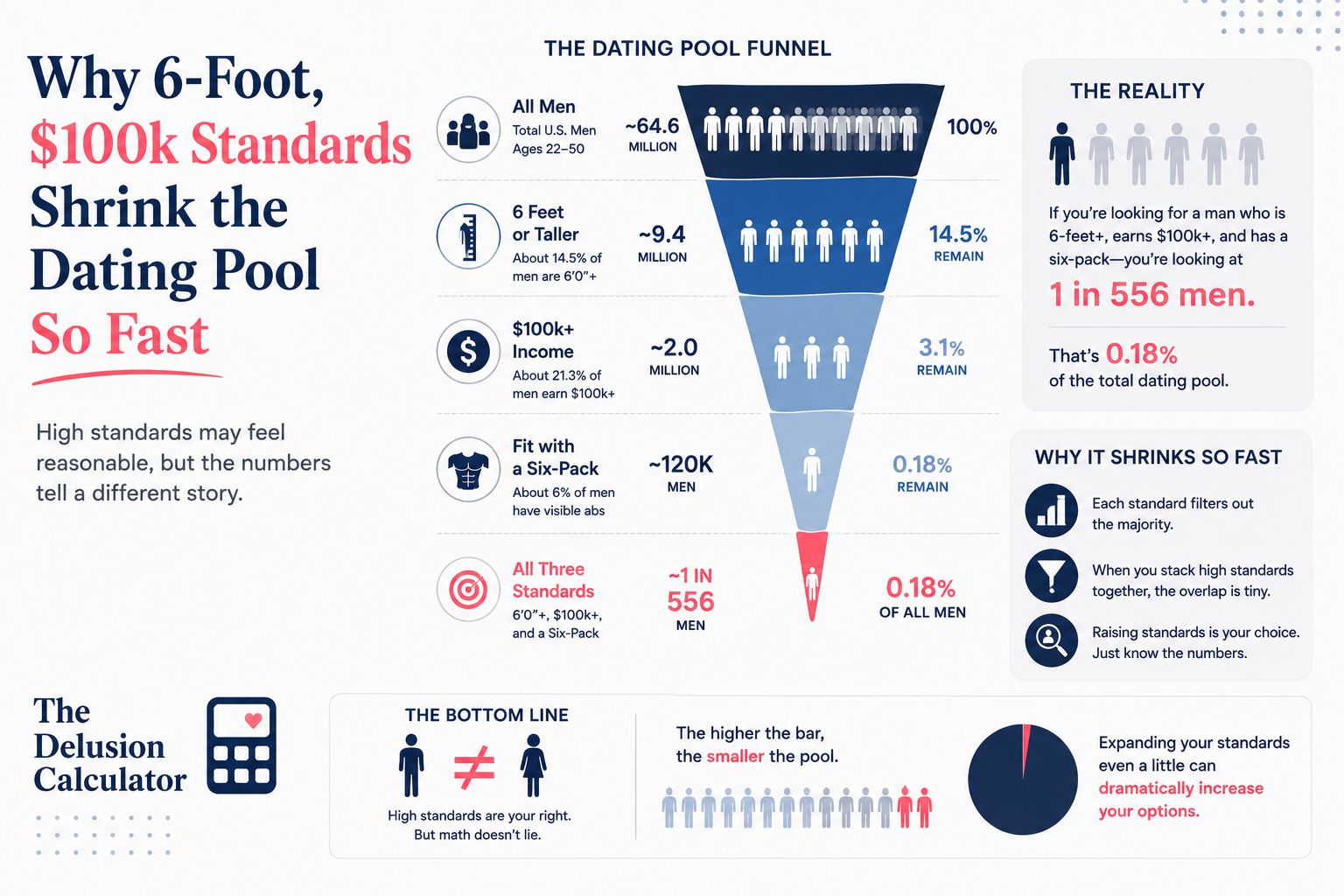
Here is where the statistic stops being trivia. Suppose a woman decides her partner must hold a university qualification. On its own that is a mild filter by the standards of this site. She keeps 37% of men and discards 63%. Set beside a six-foot minimum, which keeps only 14.5%, or a six-figure income requirement at about 18%, education is the most permissive of the three common screens.
Trouble starts when filters stack. Multiply naively and a man who is 6 feet tall, earns $100,000 or more, and holds a bachelor's represents 0.145 times 0.15 times 0.37, which is about 0.8% of men. Roughly one in 125. Reality is kinder than that, because the three traits are not independent. Graduates out-earn non-graduates substantially, so schooling and high income overlap heavily. Once the correlation is accounted for, the realistic answer lands closer to 1.5%, or about one man in 65.
Then apply the constraints that have nothing to do with preference. Restrict to a single age band, require that he be single rather than married or partnered, and require that he live within reasonable distance. Each of those cuts again. A starting population of 128 million adult men can end up in the low tens of thousands nationally, and a handful of people in any given metro area. That compounding is the entire subject of why six-foot and hundred-k standards shrink the pool.
Men hit the mirror image. A man who insists on a partner with graduate schooling is filtering into a group where women outnumber men, which sounds favorable until he adds an age preference skewed young and an appearance requirement on top. The male delusion calculator prices those combinations the same way, and the output is frequently just as brutal.
| Filter applied | Share of men who qualify | Odds |
|---|---|---|
| Bachelor's or higher | 37% | about 1 in 3 |
| Graduate or professional award | 14% | about 1 in 7 |
| 6 feet or taller | 14.5% | about 1 in 7 |
| Earns $100,000 or more | 18% | about 1 in 6 |
| Degree plus $100k | about 12% | about 1 in 8 |
| Degree plus $100k plus 6 feet | about 1.5% | about 1 in 65 |
Notice the fifth row. Adding an income test to a schooling test barely costs anything, since most men clearing six figures already have a diploma. Adding stature costs enormously, because height correlates with neither. Stacking correlated traits is cheap. Stacking independent ones is ruinous. Our page on how we model the data explains those correlation adjustments in detail, and the piece on what percentage of men make $100k covers the earnings side.
Reading the number honestly
A credential is a proxy, and a coarse one. It tracks income, health outcomes, and the odds of marrying and staying married. It tells you nothing about whether someone is curious, kind, funny, or capable. Plenty of the most interesting men in any room stopped schooling at 18, and plenty of graduates coasted through a program they have not thought about since.
If what you want is a partner who reads, argues well, and has ambition, a diploma is a lossy signal for all three. If what you want is earning stability, income is the direct measurement, and you should screen on that rather than its proxy. Using both is often redundant, as the second table shows.
The honest way to hold this statistic is simple. About 37% of American men older than 25 finished college, the figure has been broadly flat for two decades, and women overtook men on this measure roughly ten years ago while continuing to pull away among the young. Those facts are stable, well documented, and worth knowing. What you do with them is a separate question, and no dataset can answer it for you.
Frequently asked questions
Do most American men have a college degree?
No. About 37% of men over 25 completed a four-year program, so roughly 63% did not. Counting two-year awards as well, the total reaches only 46%, still short of a majority.
What is a bachelor's degree in Census terms?
A bachelor's is the award granted at the end of an undergraduate program at a degree-granting university, recorded by the Census Bureau as its own response option on the attainment question. It ranks above associate degrees and below master's, professional, and doctoral credentials.
What percentage of men have a graduate degree?
About 14% of men past 25 hold a master's, professional, or doctoral award, roughly 15 million people. That makes advanced schooling about as common among men as standing 6 feet tall.
Do women have more college degrees than men?
Yes. Roughly 39% of adult women hold a bachelor's or better against about 37% of adult men, and among 25 to 34 year olds the gap widens to nearly ten points. Women have also earned the majority of undergraduate awards granted each year since the early 1980s.
Which age group of men has the highest attainment?
Men 35 to 44 lead, with roughly 40% holding a bachelor's or better. The 25 to 34 band sits near 37%, the 45 to 64 band near 36%, and men 65 and over near 33%.
Does a college degree still raise a man's earnings?
Yes, substantially. Census and Bureau of Labor Statistics figures consistently show graduates out-earning non-graduates across a full career, and most men clearing $100,000 individually hold at least an undergraduate qualification.
How many American men hold an associate degree?
Roughly 9.5 million men over 25 list a two-year award as their highest completed level, about 9% of that group. Counting them alongside university graduates brings the combined figure near 48 million.
Is a six-foot man rarer than a college-educated man?
Yes, by a wide margin. About 14.5% of US men reach 6 feet while roughly 37% finished a bachelor's, making stature about two and a half times as restrictive a screen.
Has the share of men with degrees stopped growing?
Almost. Male attainment has risen only modestly over the past two decades, moving from the high twenties around 2000 to about 37% now, while the equivalent figure for women climbed considerably faster over the same stretch.
What share of men have no schooling beyond high school?
About 38% of adult men stopped at a diploma or equivalency or never completed secondary school. Add the 15% who attended classes without earning anything and more than half have no postsecondary award at all.
What is the college gender gap?
The college gender gap is the difference between female and male attainment rates, currently about two points across all adults and close to ten points among 25 to 34 year olds. It flipped direction in the 1980s for awards conferred and in the mid-2010s for the population overall.
Which filter cuts the dating pool more, height or a degree?
Height cuts far more sharply, keeping 14.5% of men against 37% for a bachelor's. Stacking both leaves roughly 5% of men before any age, location, or relationship-status screening is applied.